PreSonus Eris E5 Active Two-way Studio Monitor Review
Jim Odom and Brian Smith founded PreSonus in the 1995s, their ultimate goal was to offer professional sound quality at an affordable price.
PreSonus Eris E5 near-field monitor features:
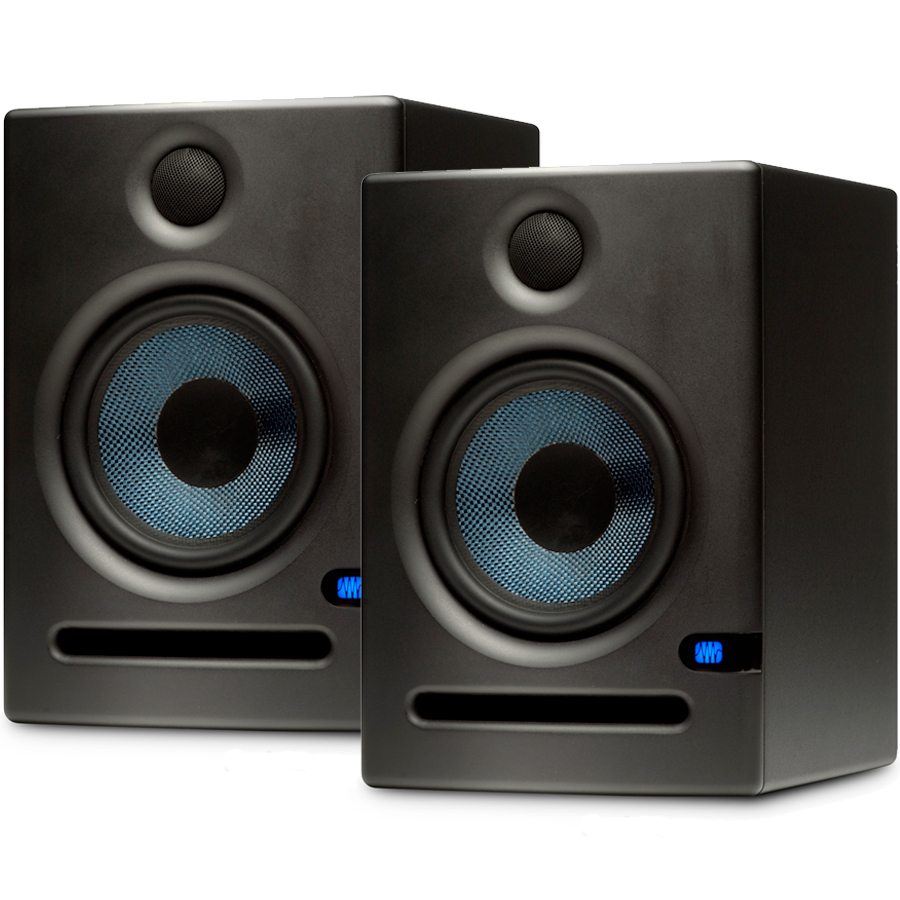
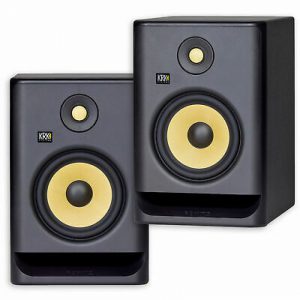
Within the frequency transmission between 53 Hz to 22 kHz, which is rather large compared to other studio monitors of this size and price, we can hear all the details you would expect from good studio monitors. The crossover frequency features a 3 kHz, 45-watt Kevlar subwoofer, a 35-watt low-weight silk dome tweeter, and a 70-watt Class AB dual amplifier.
An acoustic opening in the front panel provides the ideal bass frequency. Both the mid-range and high-range can be varied, and the surface-pass filter and acoustic space can be adjusted. Output current limitation, RF interference, overheating control, transient and subsonic protection increase the device’s lifetime. Clear, non-resonant sound is guaranteed thanks to the optimised, resonant internal stiffening feature. Symmetrical XLR / 6.3 mm and asymmetrical RCA inputs are located on the back panel. The continuous maximum sound pressure is 102 dB. But there is no need for speakers that are too loud in small to medium studios.
The laminated, medium-density fibreboard sound box measures 17.8 x 19.5 x 26 cm and weighs 4.63 kg.
-

 Bass acoustic wall panels with double leather membrane83 € – 260 € +Vat
 -

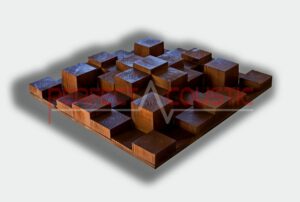
 3D acoustic diffuser 70x70x10cm122 € – 139 € +Vat

Sound quality
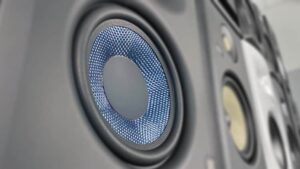
Of course, the most important thing is the sound quality. The Eris E5 offers stable and excellent sound quality. Sound is neutral, flat, which is critical to a good studio monitor. The mids were sufficiently sophisticated, the peaks were a little too sharp, and needed alignment. Bass is where PreSonus encounters difficulties. These are studio monitors after all, so we didn’t expect a pounding bass, but the bottom end could have been a little more accentuated. Again, some adjustments were needed to have a satisfactory result. As a matter of fact, these are studio monitors, not home stereo speakers. If you want pounding bass, don’t choose these speakers.
However, this close-up monitor is great for studio work. They’re loud enough to be in your immediate area, and the details we don’t usually hear on home stereo monitors were definitely discernible during Eris E5’s rehearsal. While not as sophisticated as the more expensive models, it can definitely mix and stream music at a higher level of quality than average speakers.
-
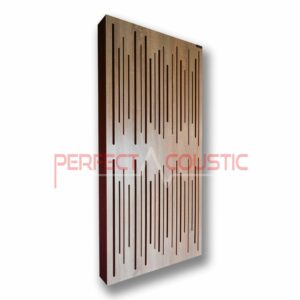
 Bass sound dampening panels with wood membranes91 € – 268 € +Vat
 -
Absorption panels with diffuser-Two in one62 € – 296 € +Vat
Design quality
Many studio monitors are made with a cumbersome solid wood box housing. The PreSonus Eris E5 is noticeably lighter than some other speakers, which is why we can assume they are cheap and of poor quality. Fortunately, this is not the case. Solid and high quality materials were used in the construction.
Kevlar low-frequency inductors have strong heat-resistant properties, and are preferred in the manufacture of speakers for a good reason. This solid material greatly contributes to extending the life of your speaker. External interference is also minimised. Although this was solved quite effectively, the speakers were still not perfect, especially at low volume, as some hissing could be heard. You may want to remove other electronic devices, such as phones, from the speakers. This helps to minimise interference.
Settings
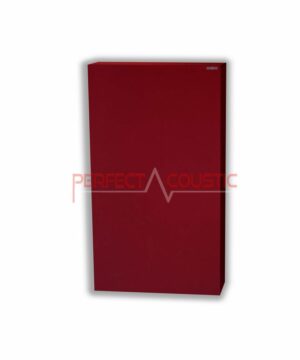
The Presonus Eris E5 allows you to adjust the centre and treble using the buttons on the back of the speaker. You can adjust each frequency for the best sound. Many cheaper studio monitors do not have this feature. Of course, it is very important to have proper acoustics in the studio. To do this, acoustic treatment of the walls must be provided. It is advisable to seek the help of an acoustic specialist and have an acoustic measurement performed, which can be used to determine exactly where and what type of acoustic panel is recommended to be placed. Broadband acoustic panels are needed in rooms where the reverberation time (echo) is higher than the reference value, in the studios the attenuation of the echoes is even more important. With the Giga bass panel with membrane, we can ensure the optimisation of bass sounds. If your studio has large glass surfaces, it is definitely recommended to purchase soundproof curtains as well, as the smooth, hard surface of the glass reflects sounds.
It is possible to adjust the acoustic space of the speaker in three ways, depending on the location of the speaker.
And finally, as far as design goes, our speakers on test seemed delicate, restrained, but perhaps a little dull for our taste.
What about the inputs
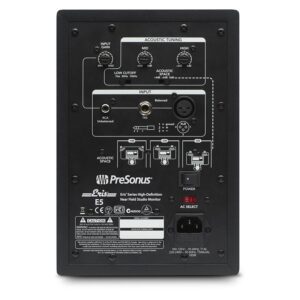
There are three connection options. Unbalanced RCA input, ¼-inch balanced TRS and balanced XLR. Using different connection options is especially good if you already have good quality cables. An RCA cable is included with the speaker, but you may also want to purchase a TRS or XLR cables.
The PreSonus Eris E5 is really affordable, especially considering the services it offers. Few studio monitors manage to offer this price, yet still provide solid performance.
The E5 offers great control for tuning the frequency response and acoustics. In addition to the standard control, the centre and upper range setting buttons are also located on the device. These buttons allow you to increase or decrease the gain of each range up to 6 pieces.
Acoustic space control allows the Eris E5 to be perfectly integrated into any room or environment. It will compensate for the frequencies based on the position of the monitor. For example, it often happens that when the speaker is close to the wall, the bass sounds become more pronounced and distort the sound. However, with these changes, we can correct these errors.
-
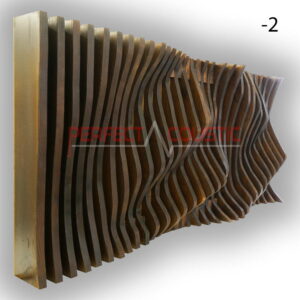
Parametric Wall Art Panel (Diffuser)327 € – 426 € +Vat
-
Wood Acoustic Diffuser 60x60x6cm108 € – 140 € +Vat
Who do we recommend the Presonus Eris E5 speaker for?
Considering its slightly weak bass, we think that for producers who like Hip-hop or other similar genres, but who rely heavily on bass, this may not be the ideal choice of speaker. Otherwise, these speakers are suitable for a wide range of musicians, especially if we consider the versatility of the rear panel controls.
For novice sound engineers, or hobby musicians and professionals alike, the Eris E5 can be a great choice that works well in a wide variety of environments. These monitors are affordable, easy to carry and offer versatile mode of usage depending on the environment. They sound neutral, the treble and midrange are adequate after some adjustments. The bass sounds, on the other hand, are not strong enough for the Presonus model.
G.H.
Written by Róbert Polgár