Musical Fidelity Nu-Vista 800 Integrated Stereo Amplifier Test
Musical Fidelity has been manufacturing audio and hi-fi products for more than 30 years, founded by Anthony Michaelson.
Nu-Vista 800 amplifier
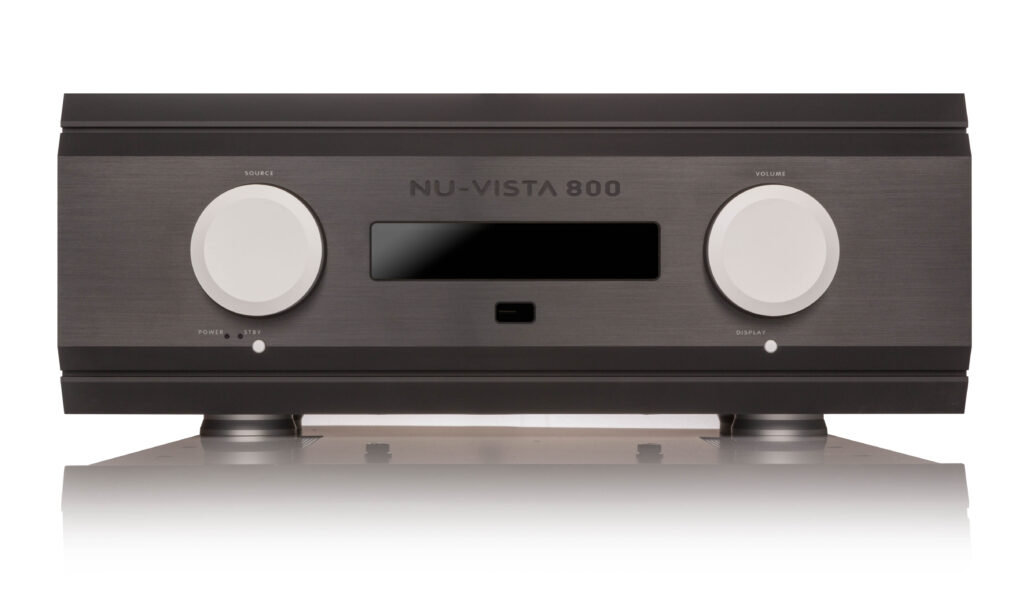
The Nu-Vista 800, available in black and silver, is rather large in size compared to other amplifiers and weighs 39 kg, thus excluding it from the club of foam light amplifiers. There are two large dials on the front for volume control and source selection, and a liquid crystal display, and a power button. Large, thick heat sinks on the side of the amplifier ensure proper cooling.
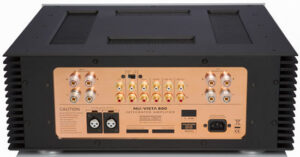
The power delivered per channel is 330 watts. The back of the amplifier has 4 pairs of RCAs, a pair of XLR inputs, and 2 pairs of RCA outputs. The latter can be used to change the signal level. Double cabling is also possible, the amplifier can also accept banana plugs. It is made of premium parts, it it is clearly visible at first sight.
-

 QRD Diffuser171 € – 269 € +Vat
 -
Broadband sound panel-It can even be used as a ceiling element44 € – 241 € +Vat


Nuvistor technology
The Nu-Vista series is made using Nuvistor technology, developed in the 1950s. Nuvistor is an advanced metallic electron-tube that is extremely durable, provides high performance and excellent sound and flexibility. This state-of-the-art circuitry guarantees excellent, clear, distortion-free sound and stable operation.
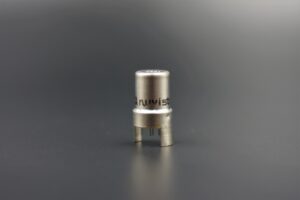
The founder of Musical Fidelity, Anthony Michaelson, bought the last operational production line and practically set up his own Nuvistor production plant. The advent of transistors has forced electron tubes to step down, they were not needed anymore in the production of audio and hi-fi products. The manufacturer subscribes a total of 100,000 hours lifespan for nuvistors. The Nuvistor vacuum tube is most often thimble-shaped, made entirely of metal, and has a ceramic base. Manufacturing requires special equipment and production line. The entire structure is assembled and then placed in a metal casing, sealed, and processed in a simple vacuum chamber with simple robotic equipment. Nuvistors are among the best performing receiver tubes and have extremely low noise levels.
The amplifier has a triode design and, thanks to direct heating, can be used safely even at high temperatures. At the top and back are small openings through which you can see the four illuminated Nuvistor tubes, which turn red when turned on and then green when warmed up.
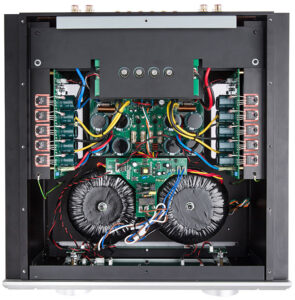
It has a symmetrical design with two large transformers and two monoblocks, this is called “dual mono”. This results in excellent channel decoupling. The frequency transmission is between 10 Hz and 30 kHz, the signal-to-noise ratio is 107 decibels, and it is equipped with a two-line output for analog recordings and headphones. The remote control is quite heavy, aluminium with satin gloss. The LED backlight can be turned off if it is bothering you. The amplifier has a thick, brushed aluminium cover, making it very rugged and stable.
The Surface Mount PCB is designed to transmit short signals, further minimising distortion. The by-pass option is also available for connection to a home theatre system. However, USB inputs are missing, which is now a basic function of almost all modern amplifiers. The Nu -Vista has an 800 bridge-connected output stage, which means that 2-2 amplifiers work counterclockwise on each side, at a load of 1 Ohm, delivering 2170 watts per side.
The dual monoblock is supplemented with a separate 1.5 kV, super quiet drive mains transformer per channel. The powerful amplifier with huge current and current reserves guarantees the fineness and speed of the amplifier, all with ease, without any constraints.
Testing
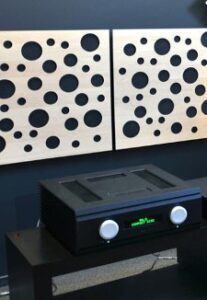
We connected the amplifier with a pair of Dynaudio speakers in a home theatre room, where acoustic carpets, curtains and printed acoustic wall panels were used to achieve a relatively ideal sound. A few more diffuser elements would be needed to create the perfect acoustics.
We tested how well it performed in the amp music field. We were first listening to Bruno Mars – Anderson – Paak: Leave the door open. The Nu-Vista 800 provided clear, sharp and detailed sounds, wide basses, extended low frequencies and an excellent stereo effect. The amplifier sound was fine and soft.
Our movie experience was akin to that of music. We opted for the crime film drama 21 Bridges first released in 2019. We had a pleasant, detailed, spacious reproduction of sound, the delicacy sometimes went to the detriment of the middle range tones, which were a bit obfuscated for our taste. The bass sounds, on the other hand, were very intense, clear, and unambiguous.
-
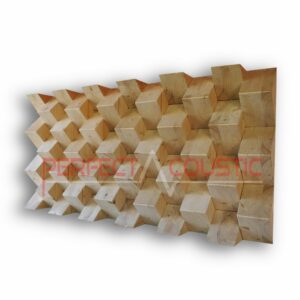
Pyramid acoustic diffuser 60x60x11cm118 € – 153 € +Vat
-
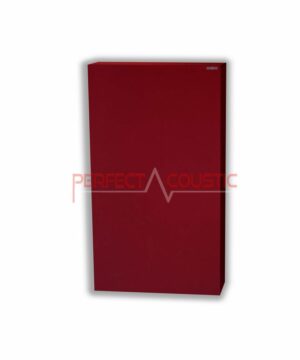
 Bass sound dampening panels with wood membranes91 € – 268 € +Vat
Summary
The Nu-Vista 800 amplifier is produced with an outdated, but extremely reliable technology, as the Nuvistor tubes can last up to 100,000 hours. We can expect reliable and durable operation from amplifiers featuring Nuvistor tubes.
Because of its large size and weight we shall carefully consider where to place it. The rich and spacious sound and the wide range of stage and stereo images compensate for everything; nevertheless objections can be made regarding the mid tones at times. The amplifier does not have a USB input, which in turn would be basic option today.
The main advantages of the amplifier are certainly the durability, high-performance, sound delivered via direct-heating electron tubes, and the two monoblocks design, which provides excellent channel coupling. It is also recommended for listening to music or for home cinema systems, as it can also be integrated into home cinema configurations with the help of the by-pass function.
G.H.
Written by Róbert Polgár