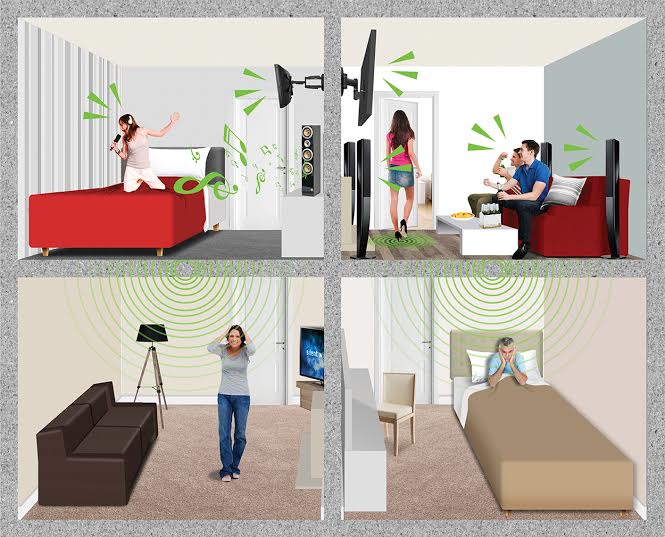
A sound is a form of energy. It can be produced, moved, carried out, distributed over time and distance, and carried a huge amount of energy. It only sounds as long as there is energy in the system to keep it running. It is best defined as something audible. It is a wave, a series of vibrations passing through a medium, within a frequency range perceptible to the human ear. It can also spread through gases, liquids, and solids, but cannot be heard in a vacuum, including in outer space. But what else do we need to know about it? Let’s see!

So the sound is a longitudinal, mechanical wave. This is caused by the back and forth vibration of the particles in the medium through which the sound wave moves. The vibrations of the object cause the particles in the surrounding medium to vibrate so that they are detected by the hearing receptors. This is called sound. It is important to note, however, that from a physical point of view, we consider the waves of vibrational motion themselves to be sound, regardless of whether the human ear hears it or not. It is also important that sound needs a medium to travel. It can travel through any medium, but as mentioned in the introduction, not in a vacuum. There is no sound in outer space because there is no medium to transmit sound vibrations. When the vibrations are fast, we hear a deep sound, and when it is slow, we hear a deep sound.
-


-
Absorption panels with diffuser-Two in one62 € – 296 € +Vat
-
3D Sound absorbing panels – Size: 60x60x10cm 3kg49 € – 59 € +Vat



Characteristics of sound waves
Sounds are usually audible to the human ear when their frequency and number of vibrations can be measured in the caliber of 20 to 20,000 per second, but this range can vary greatly from individual to individual. Sound waves with a frequency lower than audible waves are called subsonic or infrasound, and those whose frequency exceeds the audible range are defined as ultrasound. A sound wave is usually represented graphically by a wavy, horizontal line, but this graph is only a representation and not an actual image of a wave. The sound wave is caused by pressure changes caused by vibrations.
There are low-pressure and high-pressure areas
High-pressure areas are denoted as troughs and low-pressure areas as troughs, and the physical distance between two consecutive peaks or depressions in a sound wave is called the wavelength. Amplitude is the amount of compression or expansion experienced in a medium traversed by a sound wave. A large amplitude means loud noise, while a small amplitude means quiet noise.
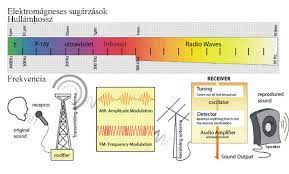
Frequency refers to the rate at which a particular sound travels through the air. It is calculated in cycles per second. The SI unit of frequency is the Hertz. Velocity can be calculated as the product of frequency and wavelength. From the formula, however, it can be inferred that there is an inverse relationship between frequency and wavelength, which means that, for example, a string twice as large as half the vibration number and a higher frequency vibration has a higher sound. The speed of sound depends on the medium: 340 meters / second in air, 1,500 meters / second in water, and finally 2,500 to 6,000 meters / second in solid matter.
As a result, sound propagates better in solids and liquids and is, therefore, more perceptible. The speed of sound can also be altered by the temperature of the medium being transmitted, albeit slightly. In warmer air, sound travels at a slightly higher speed, while in the cold air the speed travels a little lower than 340 meters per second. Because sound conductivity depends on the density of the medium, solids are better conductors than liquids and liquids are more efficient than gases. Sound waves can bounce, refract, bend, and be absorbed, as can light waves. The reflection of sound waves can result in echo – an important factor in the acoustics of theaters and auditoriums.
A sound wave can be amplified by waves from a body with the same vibration frequency, but a combination of waves with different vibration frequencies can cause beats or pulsations, or other types of interference. It is interesting to think about what this speed of 340 meters/second measured in the air means. Perhaps it is more noticeable if it is converted to kilometer/hour format, here it corresponds to 1224. At such speeds, fighter jets can travel. Supersonic aircraft can exceed the speed of sound. The popping sound that occurs at the moment of crossing is called a sound explosion.
-
-
-
Broadband sound panel-It can even be used as a ceiling element44 € – 241 € +Vat



What is hearing?
Unlike olfactory or taste perception based on chemical interactions, hearing is a mechanical process in which the ear converts sensed sound waves into electrical signals that the brain can understand. Our hearing system consists of several working components. The outer ear collects sounds that vibrate the eardrum in the middle ear. The inner ear receives these vibrations and sends them to the auditory nerve. These impulses eventually get into our brains, which translate them into what we hear. Hearing, then, refers to the awareness of the presence of sounds and the determination of the meaning of sound. It starts as a vibration that reaches the brain through the auditory system – where we hear it.
What is the decibel and how is it measured?
Decibel (abbreviated dB) is a unit of measurement used to measure the intensity of sound. The decibel scale is a bit strange because the human ear is incredibly sensitive. Our ears hear a lot, from the faint tingling of fingertip caresses to the annoyingly loud jet engine. In terms of power, the sound of the jet engine is about 1 trillion times louder than the smallest audible sound. This is a huge difference! On the decibel scale, the smallest audible sound (close to complete silence) is 0 dB. Ten times stronger sound is 10 dB. The sound is 100 times louder than nearly complete silence at 20 dB. The sound is nearly 1000 times louder than near-complete silence. Here are some common sounds and their decibels:
- Near complete silence – 0 dB
- One whisper – 15 dB
- Normal conversation – 60 dB
- A lawn mower – 90 dB
- The horn of a car – 110 dB
- A rock concert or a jet engine – 120 dB
- One shot or firecracker – 140 dB
We know from our own experience that distance significantly affects the intensity of sound – when you are away, the force decreases significantly. Any sound above 85 dB can cause hearing loss, and the loss is related to the volume of the sound and the length of exposure. Eight hours of 90 dB sound can damage the ear, and any exposure to 140 dB sound will cause immediate damage and actual pain. SzG