We have tested the Genelec 8331A studio monitor!
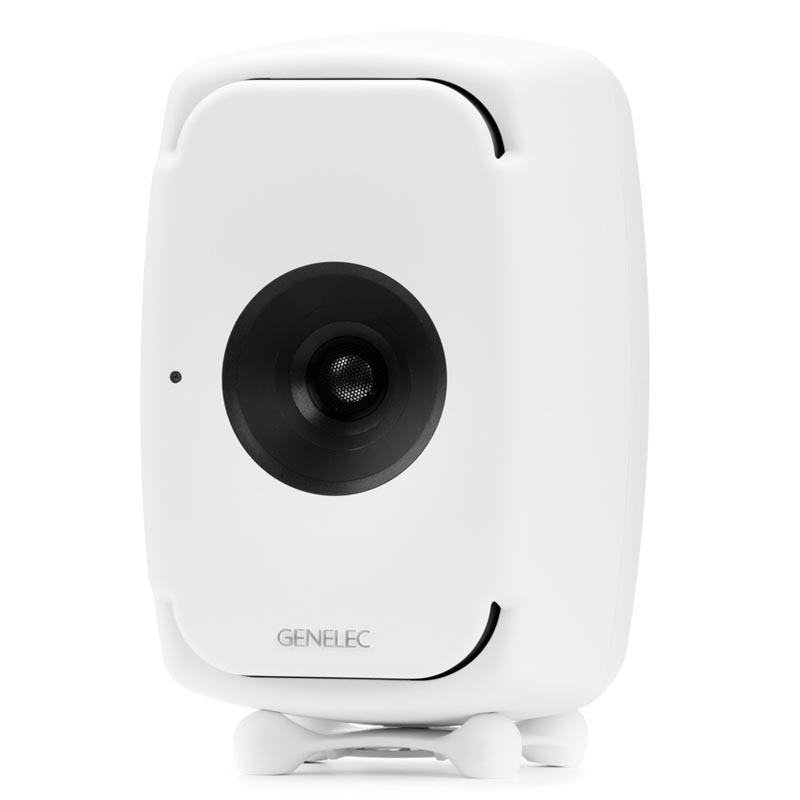
The products of the Finnish brand are known for their precise sound and premium quality. The Genelec 8331 active studio monitor is widely thought to be a relatively a heavy weight in its category, the three drives with separate amplifiers that it contains weighs 6.7 kg, yet the 8331 monitor is still the smallest member of The Ones series. The nominal frequency response is between 58 Hz and 20 kHz.
The oval subwoofer is made with acoustic concealed subwoofer technology (ACW). It has upper and lower openings. The speaker has a subwoofer of the bass-reflex type, and behind a panel you shall find a 90 mm coaxial centre and a 19 mm coaxial tweeter. This type of design is called Minimum Diffraction Coaxial Driver Technology.
-
 3D Sound absorbing panels – Size: 60x60x10cm 3kg49 € – 59 € +Vat
 -
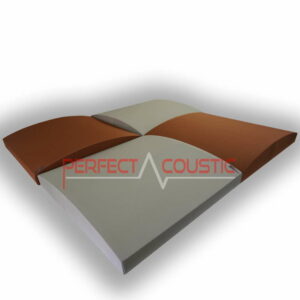
Cubic Sound Diffuser 60x60x10108 € +Vat
Directivity Control Waveguide (DCW) function
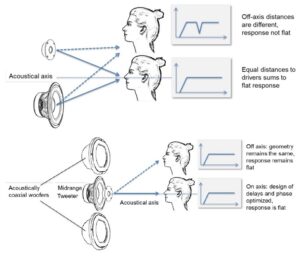
The main advantage of the three-way coaxial design is that the sound comes from a single point, so phase problems are reduced and a wider stage image is obtained. Speakers that reproduce bass notes are built into the front of the case, but remain acoustically hidden as the sound waves they emit pass through the lower and upper openings on the front panel. The cohesive front panel is actually a waveguide. This type of design also has drawbacks, such as a limited frequency range or low maximum sound pressure level (SPL), but the Genelec 8331 has eliminated these flaws, according to the manufacturer.
The baffle that influences the direction of the sound waves, at first glance, looks like a high dome guard, but in reality, this sound wave baffle runs through the entire front panel. Thanks to the coaxial drives, the stereo sound will be much sharper and more stable. Thanks to the DCW, the baffle acts as a driver-optimised waveguide, virtually minimising resonances, it is called a Minimum Diffraction Enclosure (MDE). Thanks to the coaxial design, the speakers output is optimal from up to 40 cm.
Software and hardware
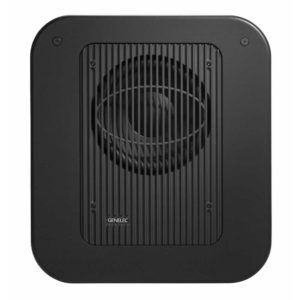
Genelec Autocal is an automatic calibration software that is extremely easy to install and use. Since the Genelec 8331 is a SAM studio monitor made with intelligent and active surveillance technology, calibrations can be performed using the Genelec Speaker Manager and GLM software, moreover the tone can also be adjusted. The subwoofer has 72 watts, the centre speaker 36 watts, and the tweeter 25 watts. The speaker has analog and digital audio inputs. Analog, balanced XLR input, digital AES / EBU balanced inputs are also available on the device.
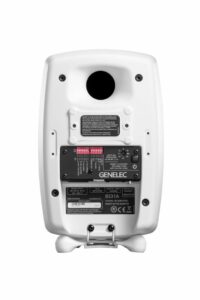
The DIP switches on the back can be used to adjust the frequency responses as well as the low and high ranges. If you want to use the speakers alone, you will need to connect a source to make the volume and other settings. The Genelec Loud Speaker Manager is a monitoring software for the settings of the device itself, and these settings are controlled by the GLM software on your computer. GLM hardware and software work extremely well together. You can connect the hardware to your computer via USB, and you can also find an input for the calibration microphone. Calibration of the EQ software is extremely fast, with a volume slider, mute, and EQ bypass buttons displayed on the control screen.
The Genelec speakers feature a rounded, sleek design, the exterior of the 8331 monitor was designed by Harri Koskinen.The company has been making speaker enclosures from recycled aluminium since 1996. The housing is quite solid and stable.
The maximum sound pressure level (SPL) of the device is 104 dB. The SAM system, the GLM software and the GLM user kit together allow for extremely precise settings. The GLM also includes a user-ready adapter, measuring microphone, USB cable and network cable. The DIP switches on the back allow you to make manual adjustments, and the upper and lower slots are used to adjust the bass tones. The reflex port system is a long curved tube inside the speaker, the purpose of which is to reduce the resonance and increase the detail and intensity of the deep sounds.
Little but loud
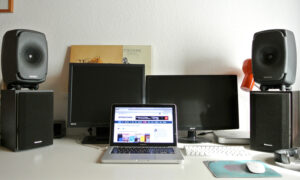
We tested the Genelec speakers in a relatively small studio. They were placed about three meters from the listening position – it is worth to mention that they can also be used as close-up monitors. Despite the small size, the monitors were extremely loud, produced muscular basses and good dynamics, the sound was balanced, and the stereo sounding accurate, clear, full, and detailed.
The acoustic treatment of the studio is in progress, consequently the sound was not completely perfect. Without calibration, certain sound frequencies pounded too loudly in this room without proper acoustic design. Room acoustics calibration software can be extremely useful when used in a studio with ideal acoustic conditions. These software primarily measure sound pressure values and are unable to correct acoustic issues such as echoes or inadequate reverberation time. If you are really looking for the perfect solution, be sure to use appropriate acoustic elements that are designed for the room. In a room treated with diffusers and sound-absorbing panels, EQ calibration programs are really useful, and flawless sound can be achieved as a result of fine tuning.
We tried the monitor while listening to stereo music. We first put on a song by Pink Who knew. Everything was absolutely fine with the stereo sound, we experienced the right multidimensional stage picture, the reverberation time was absolutely acceptable, the sound was precise and detailed, the dynamics were also absolutely perfect. Genelec 8331 were an excellent choice to serve as reference monitors. Jennifer Lopez’s hit In the morning followed. The momentum and detail, as well as the accuracy were adequate akin this time, we couldn’t really find any issues in connection with the sound.
-
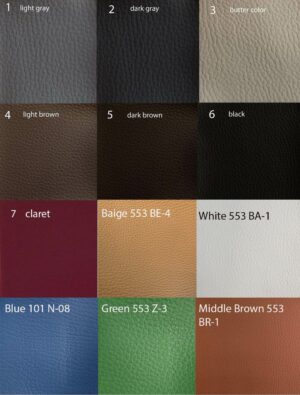
 Sound absorber leather membrane49 € – 253 € +Vat
 -

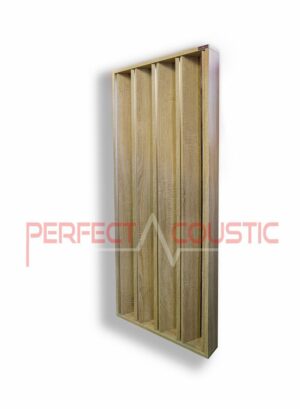
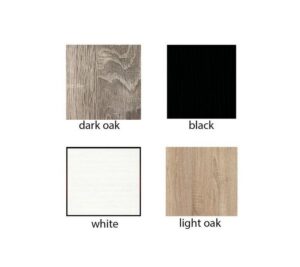
 Column Diffusers179 € – 288 € +Vat
Verdict
The Genelec studio monitor, despite its small size, is capable of astonishingly powerful sounds. We could hear intense, clear basses, balanced mid-range, and the stereo sound and 3D stage image were also ideal. EQ settings have proven to be really useful as calibration was especially important in a studio without acoustic design.
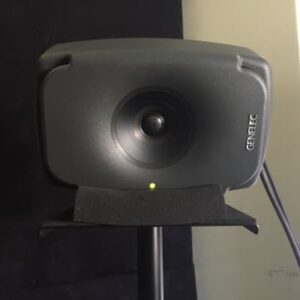
Thanks to the coaxial design, the speakers can be placed vertically or horizontally and this flexibility is a major advantage. We also recommend these speakers for smaller studios as they can also be used as a close-up monitors providing excellent sound qualities from a distance of up to 40 cm. If the acoustic treatment of a given room is difficult, due to the limited floor space, the Genelec monitor could be an optimum solution.
Not many negatives were observed during testing, but the high price can be a disadvantage. We recommend these speakers specifically for studios, but for your home opt for different ones.
G.H.
Written by Róbert Polgár