JBL Flip 5 vs JBL Charge 4 The Great Bluetooth Speakers Test
We had tried the predecessor of the JBL Flip 5, the JBL Flip 4 before and it made a really positive impression on us, so we were very curious to see to what extent the newer models, the Flip 5 and the Flip 4 Charge, are different from it.
The exterior of the JBL Flip 5 hasn’t changed much from its predecessor. The usual cylinder shape, size and design are also very similar to the Flip 4. It is waterproof up to a a depth of 1 meter, IPX7 certified and features rubber protection against damages. The 20 Watt RMS performance is quite serious compared to its size. It has 1 4.4 x 8 cm speaker and 2 side passive bass radiators.
-

 Sound absorber leather membrane49 € – 253 € +Vat
 -

 Column Diffusers179 € – 288 € +Vat
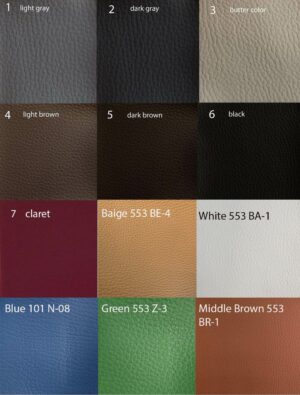
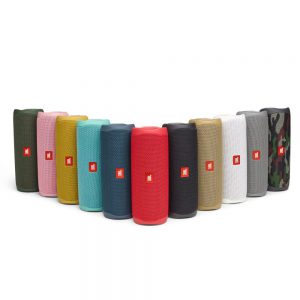
The manufacturer offers 11 colour versions. Unlike the Flip 4, the charger has a free USB-C connector. The 3.5mm Jack socket lags behind it. Instead of the special connection mode called Connect (that is able to connect up to 100 Flip speakers), it was given a Party Boost function, which can pair two Flip 5 speakers. (Unfortunately, the Connect program we enjoyed on the previous Flip models isn’t supported by this new model.) But honestly, we don’t really see the point in connecting multiple Flip speakers, as it makes more sense pairing sturdier speakers instead such as the JBL Boombox or UE Hyperboom.
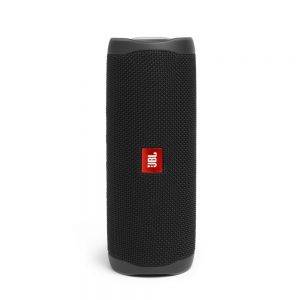
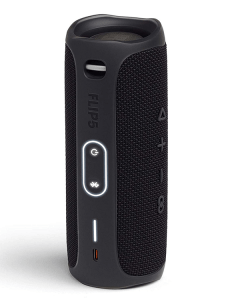
It can be expected to last about 12 hours and has a range of about 10 meters. However, hands-free phone calls cannot be made with it. Speaker frequency transmission is between 65 Hz-20kHz and weighs 540 grams. The power supply, Bluetooth pairing button and USB-C input are on the back. The buttons have lights around them when the device is on. Of course, there are also an on / off and volume control buttons on the speaker. The shoelace-like wrist holder has not changed compared to the Flip 4. It is equipped with a 4800 mAh lithium-ion battery.
Sound test
It really doesn’t matter where we listen to the speaker. We first tried JBL in an acoustically ideal room, then in a small study with pretty unfavourable acoustics, and finally we went outside and listened to it in the garden. We found that the small, portable speaker sounded very nicely, clearly, although the mid- and high-range sounds proved to be a little weak. In the study with unfavourable acoustics, we experienced some reflection problems that caused the sound to lose some of its purity. We were quite satisfied with the sound even at high volumes when tested in the garden, the medium and high sounds were weaker than expected in this case as well, but the bass tones seemed to be better and more intense in the open space, which is important for a portable speaker.
-
Giga bass panel with membrane94 € – 129 € +Vat
-

JBL portable speakers are also ideal for computers or laptops, or even make great music for parties and garden parties. If used indoors, be sure to provide acoustic treatment for the walls and ceiling of the room. In a room with echoes, even the most expensive audio and hi-fi devices do not sound properly. Outdoors, we obviously can’t attenuate outside noises, so the sound from a portable speaker doesn’t come close to the quality of the sound emitted by more powerful speakers.
The design of the JBL Charge 4 is almost identical to the look of the Flip 5.
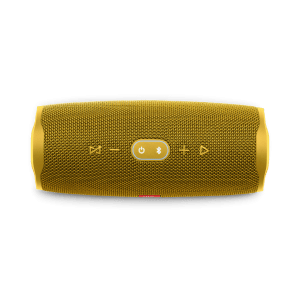
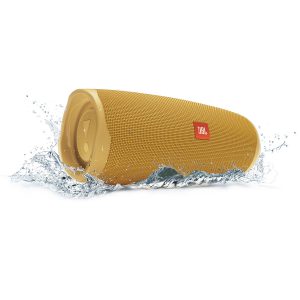
The Charge 4 is also waterproof, but has a JBL Connect feature, similar to the JBL Flip 4. What makes it different from other models, however, is that thanks to its 7500 mAh battery, up to 20 hours of playback is possible. Approximately 3.5 hours of charging is required if totally run flat. It could have been more vivid in its sounding, but it performed very well in terms of bass frequencies.
Conclusion
JBL products stand out from Blutetooth speakers due to their excellent sound. Although the Flip 5 is a newer model, we would opt for the Flip 4 or the Charge 4. As far as the downsides of the Flip 5 are concerned, we shall mention its inability to be used to make phone calls, unlike previous models, and it does not have JBL Connect, but the Party Boost that only connects with another JBL speaker having the same feature. One of the great benefits of the Charge 4 is that it can last almost an entire day on a single charge thanks to its huge battery. In terms of sound, we can’t really complain about either model performance, it is absolutely remarkable indeed that such a small device is capable of such serious performances. However, it matters a lot where we used the device and what acoustic conditions the room had. Both the Flip 5 and Charge 4 are waterproof, so you don’t have to worry about using them outdoors under the rain, spilling a drink on it, or letting fall into the pool.
G.H.
Written by Róbert Polgár