Onkyo TX NR676 Home Theater Receiver Review
The Onkyo audio and hi-fi brand has been striving to produce products with perfect sound quality since 1946. It can be said that they are quite successful in this, as evidenced by their many award-winning products.
Let’s see what the TX NR676 home theatre receiver has under the hood!
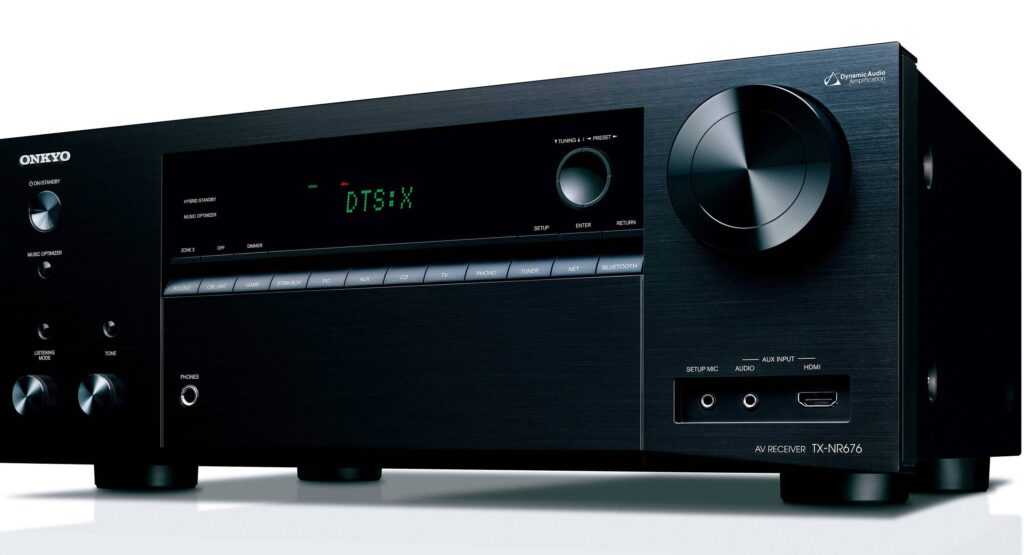
The amplifier nests a 7.2 system and is virtually no different in appearance from previous Onkyo home theatre amplifier models. It has been observed in recent years for other brands as well, which produce more advanced audio and hi-fi products, that engineers put latest technology in the previous models housing. The main reason for this is probably that even significant changes in terms of design cannot be achieved anymore, but the technology is constantly evolving, so the emphasis is on using the most up-to-date technologies possible for perfect and even more professional sound quality.
-

 QRD Diffuser171 € – 269 € +Vat
 -
Broadband sound panel-It can even be used as a ceiling element44 € – 241 € +Vat
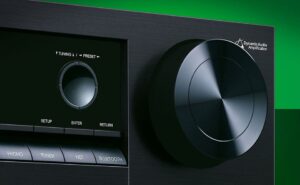
This amplifier has a square, practical design, the display is readable even from a distance. Under the display you shall find the input selection buttons. There is a slightly oversized volume control on the right side of the front panel and the connections are on the back. To say it frankly, it is a rather awkward practice to place the USB input on the back of a device, it would have been more practical if the USB connection was located on the front panel.
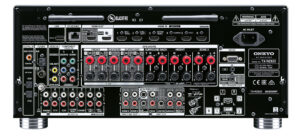
It has seven HDMI inputs, one of which is on the front panel. The HDMI inputs can also convert 4K / 60hz UHD signals and are HDCP 2.2, BT 2020, HDR10 and Dolby Vision compatible. 2 optical, 1 coaxial, 2 composite video, 2 component video, 6 stereo RCA inputs and 1 Phono input can also be discovered on the back. Thanks to the Phono input, lovers of vinyl records can also be satisfied. We noted sadly that the Onkyo home theatre amplifier is missing the 12-volt Trigger output. There is no shortage of outputs though: 2 HDMI outputs, 9 speaker outputs, 2 subwoofer outputs, 1 headphone output, a Zone 2 output, and in addition to these there is a LAN connector and a plug for an FM / AM antenna. The TX NR676 weighs 10 kg and measures 435 x 173.5 x 378 cm. Connectors are arranged ergonomically. The frequency transmission of the amplifier is between 10 Hz and 100 kHz.
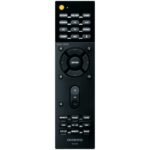
The remote control is absolutely handy, yet a bit small, which unfortunately requires the buttons to be tiny. It does not have a backlight.
Other features of Onkyo TX NR676 home theatre amplifier
The Cirrus Logic home cinema amplifier decodes with a quad-core, 32-bit, CS49844 DAC chip, supporting Dolby Atmos, DTS: X, DSD formats for SACD discs and, of course, previous Dolby and DTS audio, as well as 192 kHz / 24 bit file formats as well. (FLAC, WAV, AIFF, ALAC)
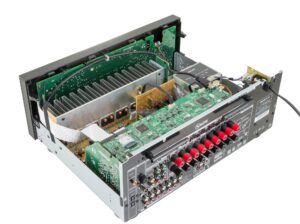
Low-impedance -4-ohm speakers can also be powered by this amplifier. At one channel load, the power for a 150-watt 6-ohm speaker was estimated by the manufacturer to be slightly lagging behind the amplifier, because in reality, contrary to the manufacturer’s claim, for 4-ohm speakers, we can expect 80-120 watts of power with low distortion. The FireConnect system is very useful, which can also be used for integration with a multiroom system. By downloading the Onkyo Controller application, the system can also be controlled via mobile devices. Of course, as with other home theatre amplifiers in similar categories, streaming is possible here, making TIDAL, Pandora, Deezer or Tuneln radio available. Airplay and Bluetooth, as well as Wifi connectivity, are available, and Chromecast or DTS PlayFi are available after a software update.
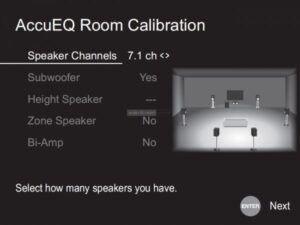
What was a pleasant surprise for us in this price range is the AccuEQ room acoustic calibration system, which offers a 15-band, multi-setting option, can store three user settings in its memory, and also recognises NTFS formats, which was also a pleasant surprise.
The amplifier has a Music Optimiser function, which is primarily designed to enhance the quality of compressed digital songs, but based on our experience and during the rehearsal, it also improved the clarity of the sounds and amplified the bass when playing vinyl records. And Onkyo’s Vector Linear Shaping Circuitry (VLSC) feature reduces pulse noise.
-
Pyramid acoustic diffuser 60x60x11cm118 € – 153 € +Vat
-
 Bass sound dampening panels with wood membranes91 € – 268 € +Vat
Test
We first tested the Onkyo receiver while listening to music, pairing it with a pair of Focal Chora 826 stationary speakers and a Velodyne Digital Drive Plus18 subwoofer. We kicked off the sound testing with the Green Day band’s song 21 Guns. The amp sounded dynamic and vivid, we experienced strong, definite deep and mid ranges, the deep tones were precise and directional, we found that Onkyo performed correctly at all volume levels. This was followed by The Weekend False Alarm, and our assessment remained unchanged. Detailed sound and a wide stage picture could be obtained, and at low or higher volumes, the amplifier’s sound production was clear with low level of distortion.
After listening to music, we also tested the device while watching a movie. We first screened the movie J. Edgar, which was released in 2011. We didn’t have a serious complaint about the performance of the amplifier this time either, the dialogues were understandable, although at higher volume we lacked detail at the peaks. We then continued the testing of the Onkyo receiver with the 2018 movie Extinction. The surround sound was stunning, as was the dynamics and momentum, the bass we felt a little overly accentuated at first, we were able to make small subtle changes with the AccuEQ settings on the receiver, which made the sounds even more accurate and even more beautiful.
Of course, a room acoustic enhancement software is only useful if the acoustics of the room are already adequate. To do this, it is recommended to place acoustic panels on the walls and ceiling. We can achieve the best sound if we use not only sound-absorbing elements, but also diffuser panels. Acoustic treatment was not yet complete at our test site, printed wall panels on the walls were placed, but based on our measurements, diffusers and corner bass traps will also be required.
Conclusion
The TX NR676 home theatre receiver is a very good device in this price range. The surround sound, momentum and clarity were adequate. We’ve also tested much more expensive home theatre amps that had fewer features or performed less well. This model made by Onkyo, although not in the premium high-end category, is equipped with almost all modern technologies and features. The dynamics and strength of sound still need to be improved, it could have been better, and we sometimes felt a little too restrained about the tones too. In the case of the remote control, it would be good to get a backlight, since in a cinema room it is advantageous to see the buttons on the remote control even in the dark, which are, as a matter of fact, too small anyway. At all volumes the amplifier sounded nice and clear, at higher volumes we lacked details at the peaks, and the bass sounds might sometimes seem too intrusive at first glance, so here we needed to fine-tune the room calibration system to eliminate them. Otherwise, the receiver produced precise and directed depths.
G.H.
Written by Róbert Polgár